Journal of Seven Heavens

Journal of Seven Heavens

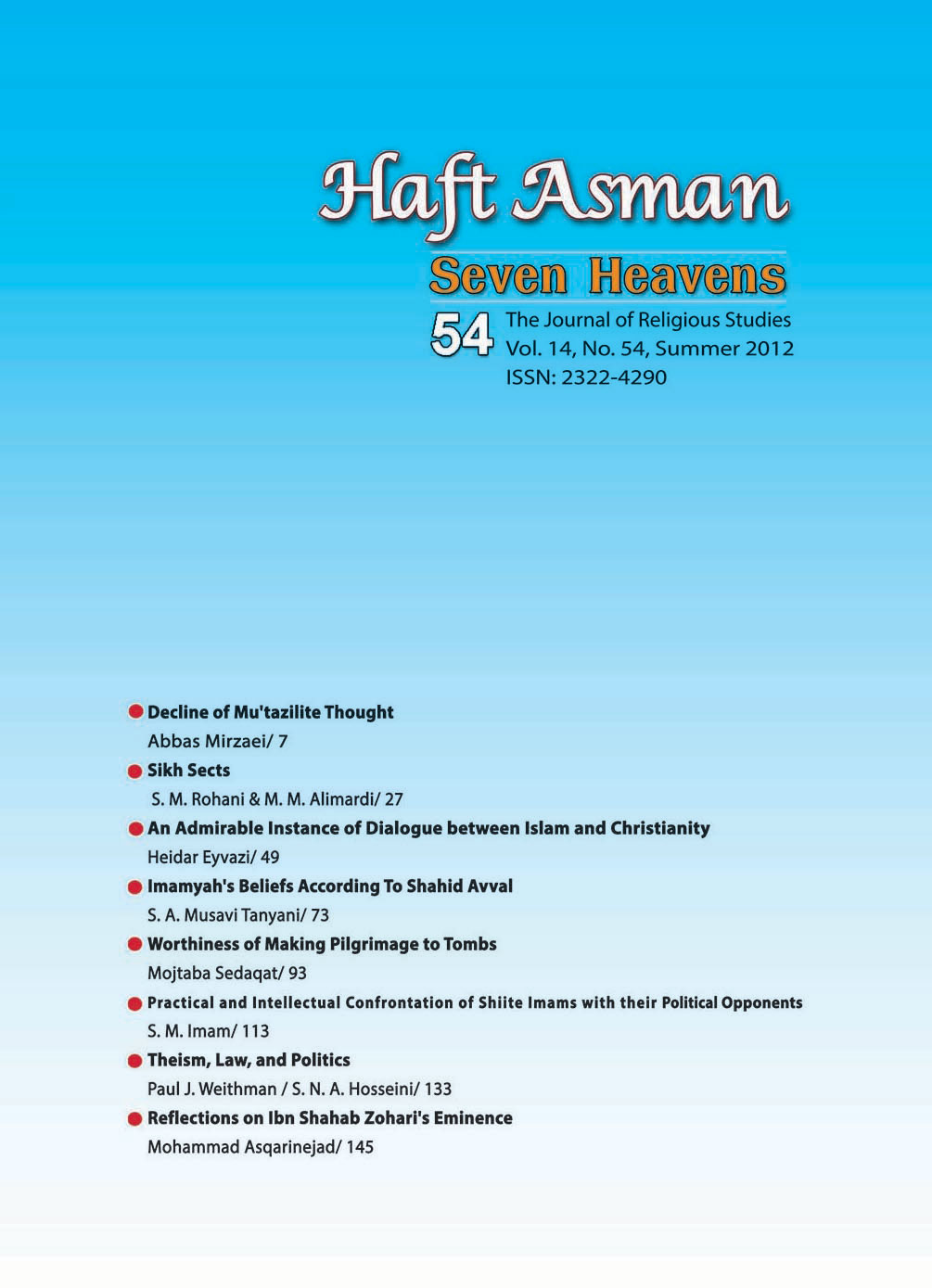
Theism, Law, and Politics

Document Type : Original Article

Authors
phd student
Abstract
In this paper, Paul J. Weithman considers the relationship between religion and politics. He is a member of several philosophical associations in the U.S., and winner of book of the year award of the North American association of social philosophy for his book entitled Religion and Citizen Duties, in 2002. He declares that along with the emerging of Protestantism, European society, which had been shaped based on the religion, was disunited and religious pluralism challenged religion deeply. In this respect, Weithman first considers the origin of liberalism, its types and most important contemporary theory, i.e., Rawls' liberalism. Then, he looks at the views of the critics such as Pope John Paul II, Taylor, MacIntyre, and Hollenbach, who have criticized liberalism from either religious or philosophical perspectives. According to Weithman, domination of theism and its great influence upon the present policies has encounteredthe political philosophers to serious challenges, with which they have to deal.
 
Keywords

Douglass, R. B., and D. Hollenbach, SJ (1993). Catholicism and Liberalism, Cambridge: Cambridge University Press.
Greenawalt, K. ( 1988). Religious Conviction and Political Choice, New York: Oxford University Press.
Hauerwas, S. (1981). A Community of Character, Notre Dame: University of Notre Dame Press.
John Paul II (1995). Evangelium Vitae [The Gospel of Life], New York: Random House.
MacIntyre, A. (1981). After Virtue, Notre Dame: University of Notre Dame Press.
Murray, J. C., SJ (1960). We Hold These Truths, New York: Sheed & Ward.
Rawls, J. (1993). Political Liberalism, New York: Columbia University Press.
Taylor, C. (1993). Reconciling the Solitudes, Montreal and Kingston: McGill-Queen's University Press.

  • Receive Date 20 April 2010
  • Revise Date 18 October 2011
  • Accept Date 17 October 2012